How to Choose the Perfect Sunglasses for Your Face Shape and Personal Style
Face shape tells you which proportions will flatter you. Personal style tells you which pair you will actually reach for. A considered guide to choosing sunglasses that look like they belong to you — cat-eye, aviator, rectangular, round, oversized and geometric, and the frame colours that change everything.
August 10, 2026
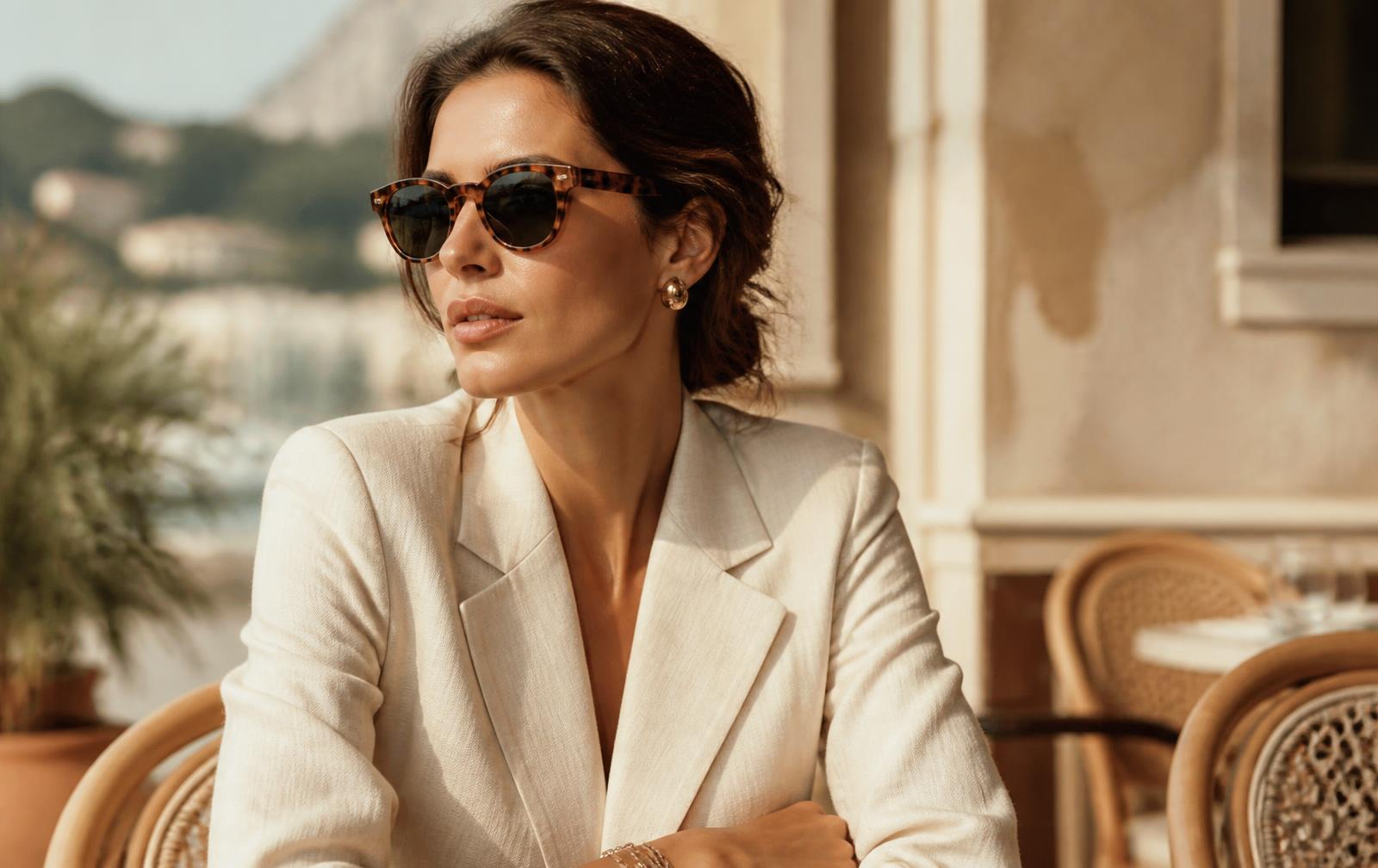
Sunglasses are the most decisive accessory a woman owns, and the least considered. A bag can be chosen at leisure; a shoe can be forgiven. But a pair of sunglasses sits at the exact centre of the face, in the place where everyone looks first, and it changes the impression you make before you have said anything at all.
Which is why the usual advice — the chart of five face shapes with a recommended frame beside each one — is useful but incomplete. It will tell you which proportions flatter you. It will not tell you which pair you will actually reach for on a Tuesday morning, and that, in the end, is the pair that matters.
What follows is how I would advise a friend: first the geometry, because proportion is real and worth understanding, then the frames themselves, then colour, and finally the part most guides skip entirely — how to choose sunglasses according to your personal style rather than a diagram. Everything here is edited from our sunglasses collection, which is where you can see the shapes described below on real frames.
Start With Proportion, Not Rules
The principle underneath every face-shape recommendation is simple enough to state in a sentence: frames flatter when they introduce the quality your face has least of, and when their width matches the widest part of your face. A soft face is lifted by a defined line. An angular face is softened by a curve. A long face is shortened by depth. A wide face is lengthened by height.
That second half — width — is the part most women get wrong, and the part that no amount of styling can rescue. A frame narrower than your cheekbones makes the face look broader; a frame that extends well past the temples makes it look smaller and slightly borrowed. When you try a pair on, ignore the shape for a moment and simply check that the outer edge of the frame sits at, or very near, the outer edge of your face.
Two further proportions are worth knowing. The top line of the frame should sit close to the brow without covering it entirely — sunglasses that hide the eyebrows erase the most expressive part of the face. And the lens depth should be balanced against the length of your nose and the height of your cheekbones: shallow lenses on a long face emphasise the length, deep lenses on a small face swallow it.
Understand these three things — width, brow line, lens depth — and you can walk into any shop and assess a pair in five seconds, whatever the shape happens to be called.
Sunglasses for an Oval Face
An oval face is slightly longer than it is wide, with a gently rounded jaw and a forehead a touch broader than the chin. It is the shape most frame charts describe as fortunate, and the reason is not mystique: because the proportions are already balanced, almost nothing has to be corrected.
This is a genuine freedom, though it comes with its own risk — the risk of choosing nothing in particular. If everything suits you, the deciding factor becomes character rather than correction, and that is where style enters. An oval face carries an aviator with unusual ease, wears a square or rectangular frame without looking severe, and can take an oversized shape that would overwhelm a smaller face.
The one caution is scale. Very narrow, very small frames tend to elongate an oval face into something closer to oblong. Keep the width at least as wide as the cheekbones and you will find that the question is no longer what suits you but what you actually want to look like.
Sunglasses for a Round Face
A round face has soft edges, similar width and length, and full cheeks with little visible angle at the jaw. It is a face that photographs beautifully and resists definition — so the useful frame is the one that supplies a line the face does not already have.
The best sunglasses for a round face are angular: rectangular, squared, or a cat-eye with a genuine upward lift at the outer corner. Straight brow lines and defined corners create the impression of structure across the upper face, and a frame that is slightly wider than it is tall visually lengthens rather than widens. Geometric shapes — hexagonal, softly squared, angled at the temple — work for the same reason and feel more modern than a strict rectangle.
What to be careful with, rather than to forbid: small round frames sit against the curve of the face and repeat it, which tends to read as costume rather than ease. If you love a round frame — and many women with round faces do — take it oversized and slightly squared at the base rather than small and perfectly circular. Scale supplies the contrast that shape does not.
Sunglasses for a Square Face
A square face has a strong jaw, a broad forehead and a width close to its length. It is a striking bone structure and it needs very little help — what it responds to is softness placed against the angles rather than more angles laid on top of them.
Round and oval frames are the classic answer, and they are the right one: a curved lens set against a defined jaw creates immediate balance. Aviators, with their soft teardrop and thin metal line, are perhaps the single most flattering frame for a square face. A cat-eye works too, provided the curve is generous and the corner lifts rather than points.
Keep the frame proportionate to the width of the jaw — too narrow and the face reads wider still — and favour thinner temples and lighter constructions, which let the bone structure show rather than compete with it. Heavy, sharply rectangular frames in thick black acetate are the one combination that can tip a strong face into severity, which is fine if severity is the point and less so if it isn't.
Sunglasses for a Heart-Shaped Face
A heart-shaped face is widest at the forehead and cheekbones and narrows to a delicate chin. The goal is to avoid adding weight at the top, and to let the eye travel downward rather than settling on the brow.
Frames that are wider at the bottom than the top do this elegantly — rimless or semi-rimless shapes, aviators with a soft lower curve, gently rounded lenses, or a light cat-eye with the sweep kept low and subtle. Delicate metal frames flatter more than heavy acetate, and a slightly oversized round lens balances a narrow chin beautifully.
The frames to approach with care are those with a heavy, decorated or embellished top bar, and dramatic upswept cat-eyes that draw the width even higher. Neither is a prohibition; both simply need the rest of the face kept quiet — hair away from the temples, a clean brow, restrained earrings — to stay in balance.
Sunglasses for a Long or Oblong Face
A long face is noticeably longer than it is wide, often with a high forehead and a straight jaw. Here the useful correction is horizontal: anything that breaks the vertical line makes the face look shorter and more balanced.
Deep lenses are the key detail — a frame with real height covers more of the face's vertical span and instantly shortens it. Oversized square shapes, wide rectangular frames, generous rounds and shield-adjacent geometric styles all work. A decorative or contrasting detail at the temple helps too, because it pulls attention outward rather than up and down.
Small, narrow, shallow frames are what to avoid; they leave a great deal of face visible above and below and exaggerate the very proportion you are balancing. If you want something discreet, choose a discreet colour in a large shape rather than a small shape in a bold one.
The Six Frames Worth Knowing
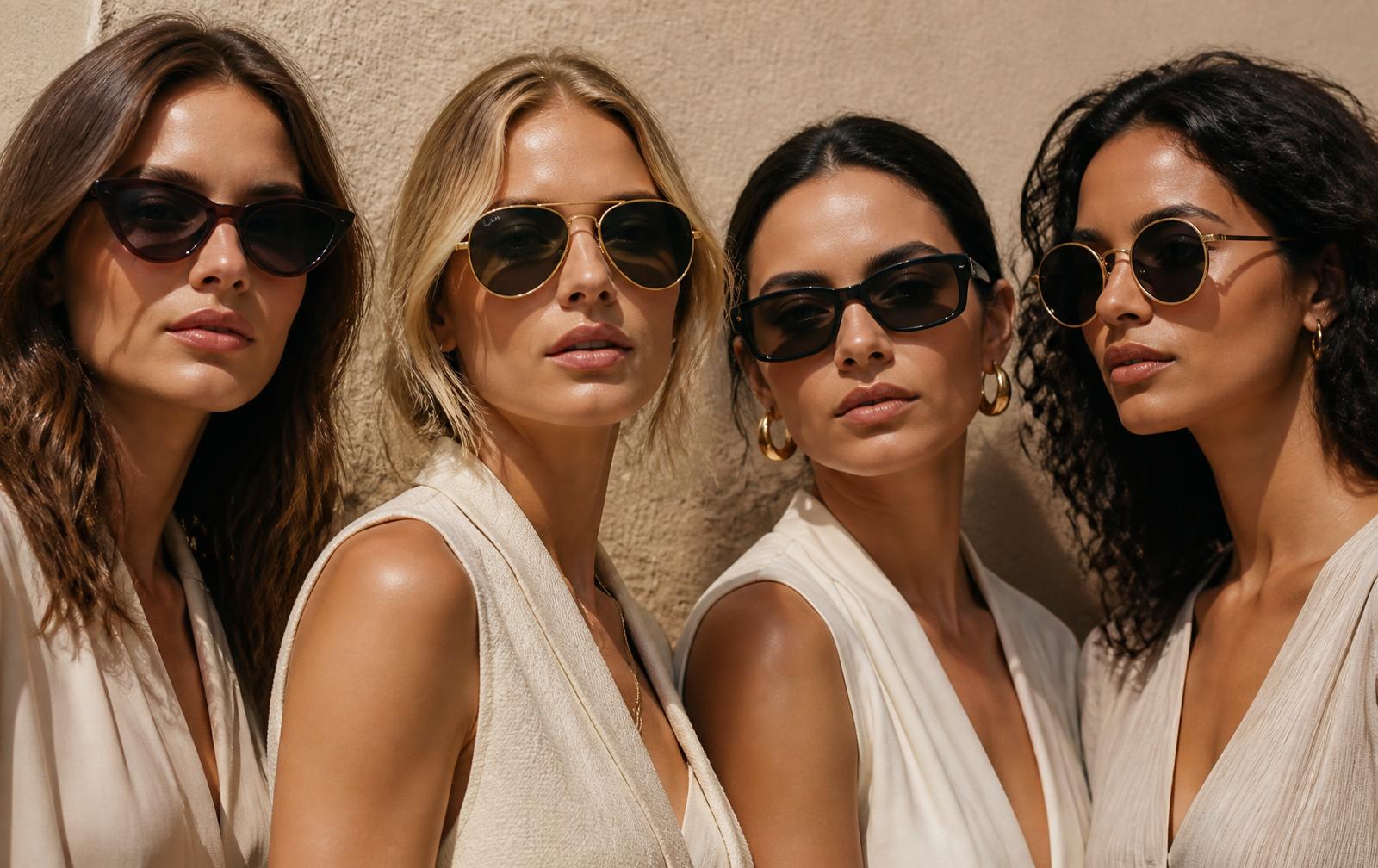
Cat-eye. The most flattering frame in the world for anyone who wants lift. The upswept outer corner mimics the effect of a well-done eyeliner and adds definition to a soft face. Modern versions are subtler than their Fifties ancestors — a slight angle rather than a wing — and read as elegant rather than retro. Best on round and square faces; wear a low, gentle sweep if your face is heart-shaped.
Aviator. The great democrat. A thin metal frame, a soft teardrop lens, a double bridge — it flatters more faces than any other shape and has the rare quality of looking equally correct with a trench coat and with a swimsuit. Particularly good on square and oval faces. Choose a size that ends at the cheekbone, not below it.
Rectangular. The frame of structure. Straight lines, defined corners, more width than height. It is the most efficient way to add angle to a round face and the most professional-looking option in any wardrobe. In a thin acetate it is discreet; in a thick one it becomes a statement, which is a different decision entirely.
Round. Softness, intellect, a certain artistic reserve. Round frames are wonderful on square and angular faces and, in larger sizes, on long faces. The distinction between chic and costume here is scale and metal: a fine gold round frame reads as considered; a small plastic one reads as a reference.
Oversized. Less a shape than a decision. Oversized frames flatter almost everyone provided the width still corresponds to the face — the mistake is not size but overhang. They are the fastest route to instant polish on an unremarkable outfit, and the reason so many women keep one pair purely for travel.
Geometric. Hexagons, octagons, angled squares, sculptural bridges. These are the frames that look most current and most personal, and they are the natural choice if your clothes are simple and you want the interest to sit somewhere. They flatter round and soft faces particularly well, since they supply the angle without the severity of a hard rectangle.
How Frame Colour Changes Everything
Two women can wear the identical shape and produce entirely different impressions, because colour, not silhouette, decides how loudly a frame speaks. This is the variable most people never consider, and it is the one that determines whether a pair of sunglasses disappears into a look or becomes it.
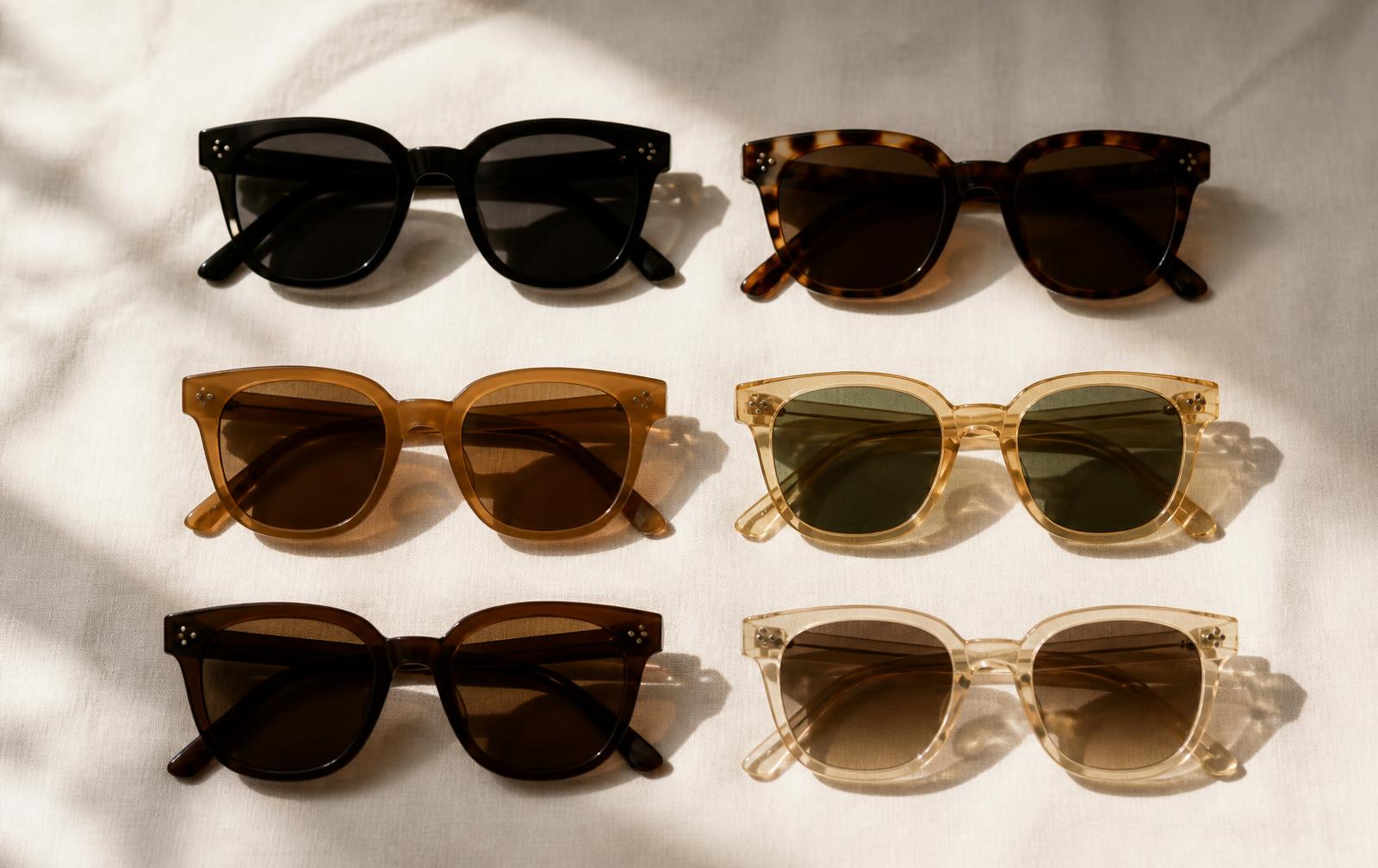
Black is the most graphic and the most severe. It draws a hard line across the face, flatters cool colouring, and sharpens everything around it — which is why it is the right choice for a minimalist wardrobe and the wrong one for anyone hoping to look soft. Tortoiseshell is its warm opposite: it borrows colour from the hair and skin, it never looks aggressive, and it is the single most forgiving frame colour there is. If you own one pair for the rest of your life, this is the sensible choice.
Honey, caramel and translucent amber sit somewhere between jewellery and glasses. They warm the complexion, they read as expensive in daylight, and they are the reason those frames photograph so well on holiday. Clear and pale champagne frames are the discreet option — they lighten the face and suit anyone who finds heavy frames overwhelming. Gold and thin metal disappear almost entirely and let the eyes stay the subject, which is exactly why aviators in gold have never gone away.
Then the colours that announce themselves: burgundy, olive, ivory, dark green, a deep transparent brown. These are the frames that make an outfit look considered rather than assembled, and they are worth having once the neutral pair is in place. A brief rule that has never failed me — match the frame's temperature to your skin, not to your outfit. Warm complexions belong in tortoise, honey and gold; cool complexions in black, grey, clear and silver. Everything else is preference.
Choosing Sunglasses According to Your Personal Style
Here is where the charts stop being useful. Face shape narrows the field; personal style chooses within it. The pair you love is the pair that agrees with the rest of your wardrobe, and a frame that flatters your bone structure but contradicts your clothes will stay in its case.
If your style is minimalist, keep the frame quiet and the quality obvious. A slim rectangular or softly squared acetate in black, warm brown or clear, with no visible hardware and a matte rather than glossy finish. Nothing decorative at the temple. The pair should read as part of the outfit's structure — the same logic that governs the quiet luxury work wardrobe, applied to the face.
If you prefer a classic wardrobe, buy the shape that predates trend: a tortoiseshell rounded square, a gold aviator, or a modest cat-eye with a barely-there lift. These are the frames that will still look right in a decade, and they belong beside a camel coat, a white shirt and a good loafer without any negotiation.
If your style is romantic, choose curve and lightness. Soft rounds, a gentle cat-eye, thin metal, rose-tinted or honey lenses, delicate temples. Anything heavy or hard-edged fights the fabrics you already wear; anything light amplifies them.
If your style is sporty or relaxed, the frame should look capable rather than decorative. A slim shield, a lightweight geometric wrap, matte black or olive, a lens that actually performs in bright sun. Worn with wide trousers, a clean sneaker and a knit, it will do more for the outfit than a pretty frame ever could.
If your style is creative, this is the accessory where you can be least reasonable. Hexagonal frames, unexpected colour, ivory or burgundy acetate, an unusual bridge. Keep the clothing plain and let the glasses carry the personality — the opposition principle that Copenhagen made its own, and which we explored in the SS27 trend report.
If you want your sunglasses to become the statement, go large and go sculptural — an oversized geometric or a wide, deep square in a single strong colour — and then take everything else down. One shiny surface, one loud object, and a quiet outfit around it. That is the difference between a woman wearing dramatic sunglasses and a woman wearing a costume.

Balancing Face Shape With Style
The two systems will occasionally disagree, and when they do, style should usually win. A woman with a round face and a wardrobe built entirely from soft, romantic pieces will look strange in the sharply rectangular frame the chart recommends — technically balanced, personally wrong. The answer is not to abandon the geometry but to find the version of it that speaks her language: a softly squared frame in warm tortoise rather than a hard black rectangle.
That is the method, more or less. Take the correction your face suggests and translate it into the vocabulary of your wardrobe. Need angle but dress romantically? Choose a gentle cat-eye rather than a square. Need softness but dress minimally? Choose a clean oval in matte acetate rather than a decorated round. There is nearly always a frame that satisfies both, and it is worth the extra ten minutes of looking to find it.
If you are not certain what your wardrobe is actually saying, it is worth establishing that first — our personal style discovery names the silhouettes and textures you naturally return to, and once you know them, choosing an accessory of any kind becomes far less arbitrary. You can browse the shapes discussed here in the edited sunglasses collection with that in mind.
The Practical Part: How to Buy Well
Try them in daylight, never under shop lighting, and look at yourself from the side as well as the front — a frame that is charming face-on and juts past the temples in profile will bother you forever. Smile while you look; if the frame lifts onto your cheeks, the fit is wrong regardless of the shape.
Pay for the lenses rather than the logo. Proper UV protection, a lens tint dark enough to relax the eyes, and a finish that does not distort colour matter more than any name on the temple. Grey and green lenses keep colours true; brown and amber warm them and improve contrast, which is why they suit driving and bright coastal light.
And buy two, eventually. One neutral pair that goes with everything and asks for nothing — tortoise or black, a shape that flatters — and one that exists purely because you love it. The first will be worn three hundred days a year. The second is the one people will remember.
Knowing how to choose sunglasses is finally a question of two answers held together. The geometry tells you what will balance your face; your wardrobe tells you what will look like you. Where they meet, you find a pair you will wear until the hinges give out.
And when they conflict, trust the second answer. The best-fitting frame in the world looks wrong on a woman who feels self-conscious in it, and a slightly imperfect one looks marvellous on a woman who is certain. Face shape is useful information. Confidence is what people actually see.
Disclosure · The selections below were independently chosen by our editors. Some links are affiliate; we may earn a small commission when you shop through them.
The Beauty Edit Style
Discover your personal style
Before deciding what to buy, it helps to understand what genuinely belongs to you. Our style diagnostic reads the silhouettes, textures and details you're drawn to — and names the identity behind them.
Curated · Tested · Recommended
Suggested to Shop
The pieces mentioned in this story, in one place — independently chosen by our editors.
- 01
The Sunglasses Edit
Cat-eye and softly angled frames
Lift and definition for round and square faces — the most flattering shape in the collection.
- 02
The Sunglasses Edit
Classic aviators in gold and metal
The frame that flatters more faces than any other and never dates.
- 03
The Sunglasses Edit
Tortoiseshell rounded squares
The one neutral pair worth owning: warm, forgiving and correct with everything.
- 04
The Sunglasses Edit
Oversized and geometric statement frames
For when the sunglasses are meant to be the loudest thing you are wearing.
Some links are affiliate. We may earn a commission at no cost to you.